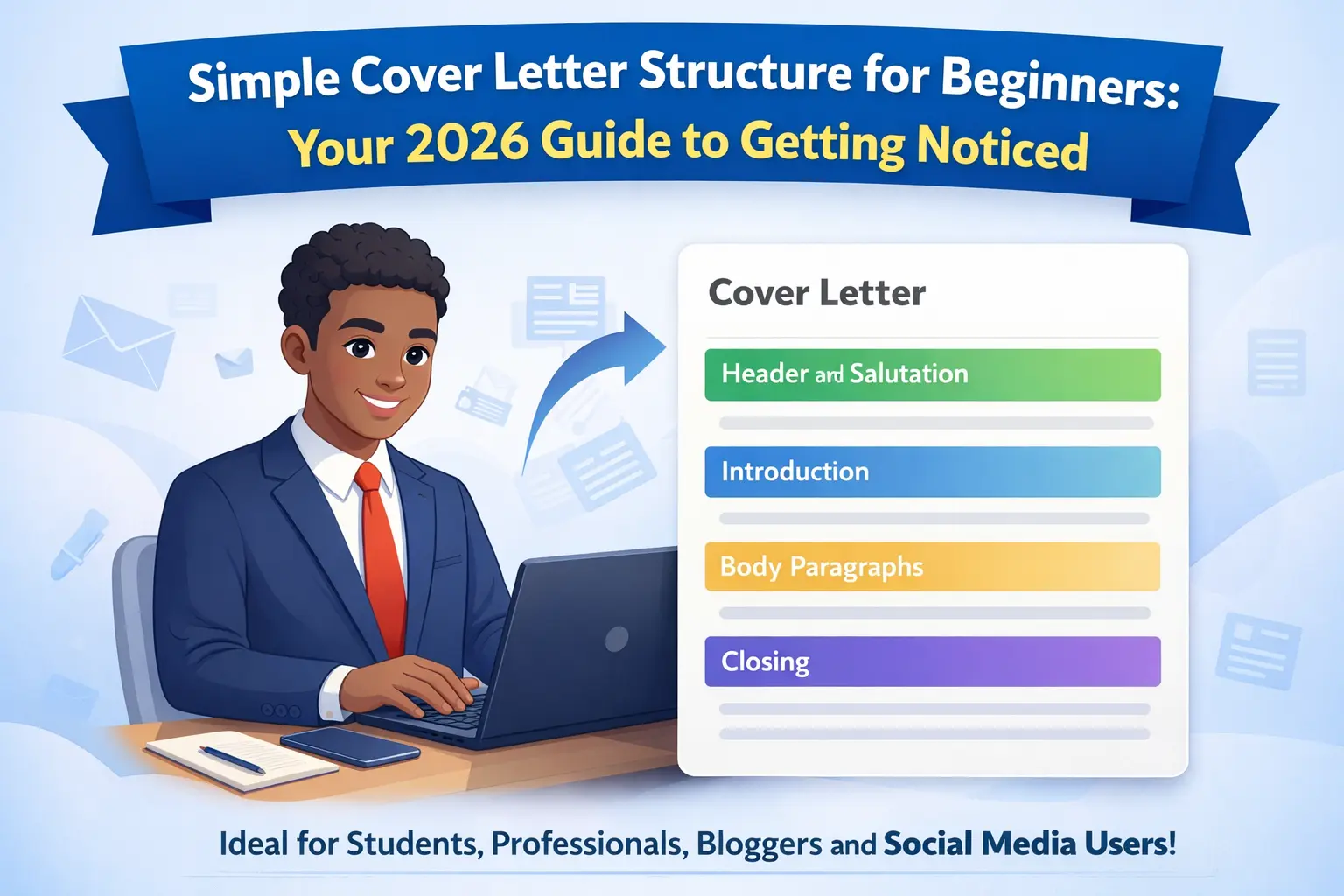
It can be hard to write your first cover letter. If you don't have much experience, you might be looking at a blank page and wondering how to sum up your skills and passion. The good news? It doesn't have to be hard. A simple cover letter structure is the secret weapon that can turn this problem into an easy and useful tool for beginners.
This guide will teach you everything you need to know, including a simple, step-by-step cover letter structure for beginners that will help you get that all-important first interview.
Why beginners should use a simple cover letter structure?
A well-organized cover letter is more than just a formality; it's a way to market yourself. It tells the employer who you are, why you want the job, and what you can do to help their team. For people who are just starting out, it's a chance to show how your skills can help them.
A simple, logical structure has a number of important benefits
- It helps the reader: A letter that is formatted correctly shows that you care about the details and the hiring process.
Recruiters usually only look at a letter for a few seconds. They can easily find the information they need if the structure is clean.
- It helps you organize: your thoughts by keeping you from going off on tangents and making sure you cover all the important points.
- It Shows Professionalism: A letter that is formatted correctly shows that you care about the details and the hiring process. A letter that is formatted correctly shows that you care about the details and the hiring process.
The 4-Part Simple Cover Letter Structure You Need
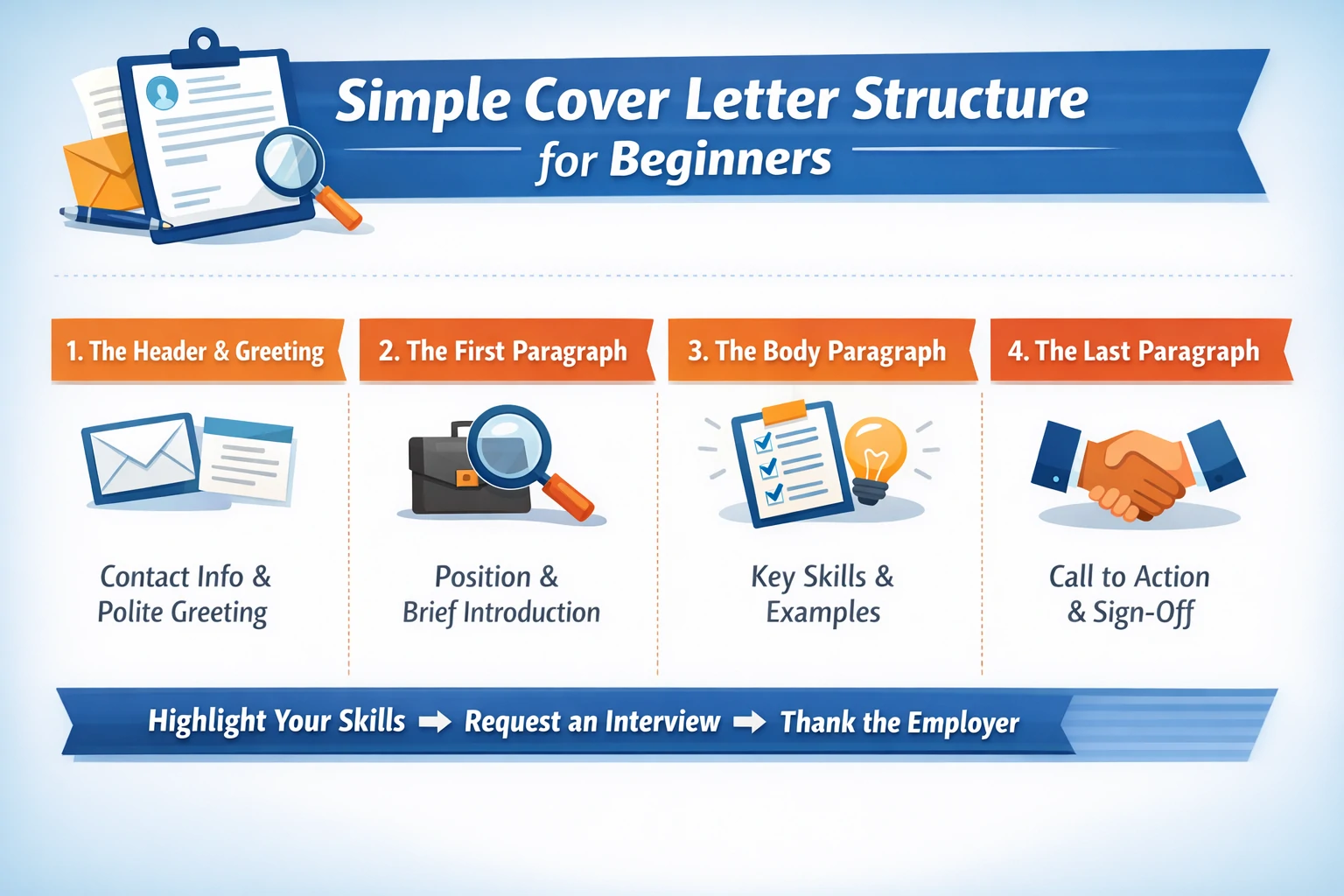
If you're just starting out, the best thing to do is stick to a classic four-part structure. You can think of it as a basic template that you can change for each job you apply for. Career experts from universities and major job sites around the world recommend this format.
Section Main Goal Key Parts
| Section | Primary Goal | Key Elements |
|
1. The Header and Greeting
|
To give your professional contact information and get in touch with the right person.
|
Your contact information, the date, your employer's information, and a polite greeting to a specific person (like "Dear Ms. Johnson").
|
|
2. The First Paragraph | Get people's attention by saying what job you want and giving a quick overview of why you're a good fit.
|
The exact job title, how you found it, and a short introduction to your main strengths.
|
|
3. The Body Paragraph(s)
|
To show that you are a good fit with specific examples of skills from school, volunteering, or life.
|
1–2 paragraphs explaining what "transferable skills" are (like communication and teamwork) with real-life examples.
|
|
4. The Last Paragraph
|
To confidently ask for an interview and end on a professional note.
|
A formal sign-off, a reiteration of interest, a call to action (asking for an interview), and thanks.
|
1. The Header and Salutation:
Getting the Basics Right This is the simplest part, but it's very important to get it right. Your header should look professional and be in the same style as the rest of your resume.
Add:
- Your Full Name
- Your Phone Number
- Your work email address (for example, firstname.lastname@email.com)
- Your City and State
- Date
Then, add the employer's phone number and address:
- Name of the hiring manager (if you can find it)
- Name of the Company
- Address of the Company
Last but not least, the greeting. Always try to get a real name. Look at the job description, the company's website, or LinkedIn. Don't use the old phrase "To Whom It May Concern." If you can't think of a name, "Dear Hiring Manager" is fine.
2. The first paragraph: Getting Their Attention
Your first paragraph should be short and interesting. You need to answer three questions in two to three sentences:Who are you? For example, "I just graduated from marketing school at..." or "I am currently a student at..."
Why are you writing? "I am writing to apply for the Junior Graphic Designer position at [Company Name], as advertised on LinkedIn."
Why should they care? For example, "My classes in digital design and my internship making content for social media have given me the skills I need to do well in this job."
Don't start your letter with something like "I am writing to apply for the job." Get to the point and drop hints about why you're a good fit for the job.
3. The Body Paragraph(s): Showing Why You're Worth It
This is the most important part of your cover letter. You might not have a lot of work experience, so you'll focus on transferable skills—things you've learned in school, through volunteering, in part-time jobs, or even in your hobbies. These can be things like working together, talking to people, solving problems, managing your time, and being a leader.
Choose two or three important skills from the job description. Give a specific example for each skill. Use the STAR method to organize your examples:
What was going on?
What did you have to do?
Action: What did you do?
What was the result?
For example,
"As the Social Media Coordinator for the university's marketing club (Situation), my job was to get more people to interact with us online (Task). I made a content calendar and a series of posts that highlighted students (Action). This led to a 35% increase in followers over one semester (Result). I can't wait to use this same creative and data-driven approach in the Social Media Assistant role at your company.
This way of saying it is much stronger than just saying, "I have good social media skills."
4. The Last Paragraph: Ending with Certainty
The last paragraph should be short and to the point. It's your last chance to make your case and get people to act.
Say again that you're interested and give a short summary of why you're a good fit for the job.
Ask for an interview. This is what you want most. Use language that is sure of itself and active.
Thank them:
Be polite and professional. "I know that my strong work ethic, ability to learn quickly, and love of helping customers make me a great fit for your team." I would love to talk about how my skills fit with [Company Name]'s goals in an interview. "Thank you for your time and thought."
Finish with a formal closing, like "Sincerely," or "Best regards," and then type your name.
Read More: How to Write a Professional Cover Letter for a Job Application, with an Example
How to Format Your Work to Look Professional
Simple structures also need formatting that is simple and clear. To make sure your cover letter is easy to read, follow these simple rules for formatting:
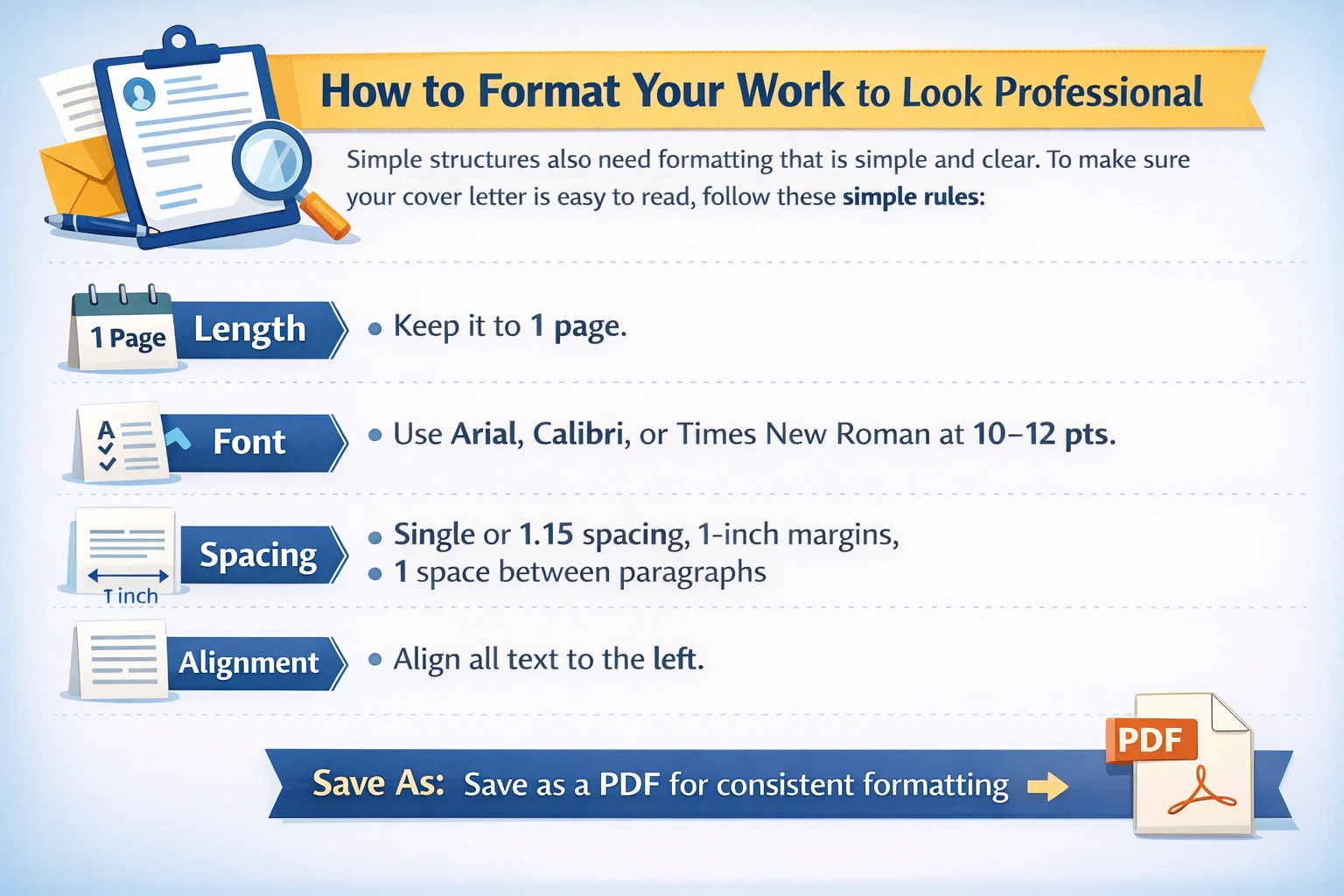
Length: One page is all you need. Font: Use a standard, business-like font like Arial, Calibri, or Times New Roman in a size of 10 to 12 points.
Spacing: Use single or 1.15 spacing and leave a space between each paragraph.
Set your margins to 1 inch on all sides.
Alignment: Make sure all text is lined up to the left.
File Type: Save your letter as a PDF and send it that way to make sure the formatting stays the same (unless the employer asks for a different format).
Length: One page is all you need.
Font: Use a standard, business-like font like Arial, Calibri, or Times New Roman in a size of 10 to 12 points.
Spacing: Use single or 1.15 spacing and leave a space between each paragraph. Set your margins to 1 inch on all sides.
Alignment: Make sure all text is lined up to the left.
Things that beginners often do wrong
There are still things to watch out for, even with a simple structure:
Being Too Generic: A letter that is too general shows that you didn't do your homework. Always make your letter fit the job and the company.
Don't Just Repeat Your Resume: Your cover letter should do more than just list your resume bullet points in a paragraph. It should add context and tell a story.
Typos and mistakes in grammar are a clear sign that something is wrong. Read your letter out loud, proofread it carefully, and ask a friend to look it over.
Focusing on What You Want: Talk about your skills in terms of what you can do for the company, not just what you want to get out of it.
Vary the way you write your sentences if you use "I" too much. Instead of saying "I did this" or "I did that," start with action verbs or phrases that focus on the result.
In conclusion
Your first cover letter is a big deal.
Writing your first cover letter is a big step in your career. You can write a strong, professional cover letter that makes a good impression by following this simple structure for beginners. It's not about having the most experience; it's about being able to clearly and confidently show what you can do. Follow this guide and make it fit each job, and you'll be well on your way to getting that first interview. Best of luck